
 My name is Paddy McKeown, I am a retired police officer (Detective Sergeant – Metropolitan Police), turned chimney sweep. I have completed training with ‘The Guild of Master Chimney Sweeps’, and Rod Tech UK (Power Sweeping).
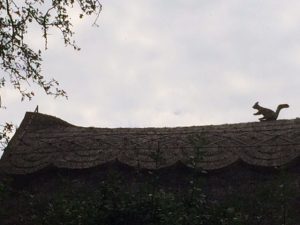
This is perhaps the most unusual thatched animal I have found so far, and is on a thatched cottage at the bottom of Roman Road in Radwinter. Although grey squirrels might be considered by some to be vermin and therefore worth shooting, I don’t think for one minute that shooting grey squirrels would in any way constitute field sport. So bang goes my theory about thatched animals being all about hunting and shooting themes! Perhaps after all this squirrel is a indigenous red squirrel, although North West Essex does not have any natural habitat for such creatures. I think that red squirrels are far more attractive than grey squirrels, they are native to the UK and they are far less destructive of the environment than their grey counterparts. So I would like to think that this is an example of a red squirrel in thatch!
In the photograph you can also see a sloping end to the ridge of the roof a feature which is frequently found on thatch properties. Myth and folk law has it that these sloping ends are a defence measure to prevent witches landing on the roof. Other witch defences found on thatched roves around East Anglia include sharp pointed stick on top of the roof. Other thatch folk law indicates that it was quite common for people to hide coins and pieces of bread in the thatching in order to ward off poverty.
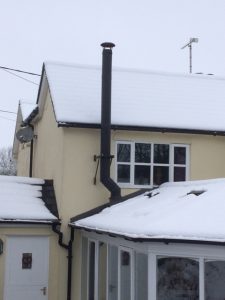

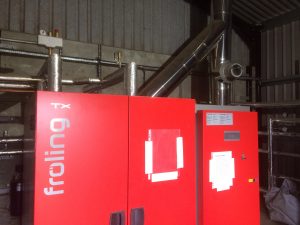 Here is another example of industrial scale sweeping that I have undertaken! I recently swept the chimney of this large biomass boiler that is on an estate in the Linton area. The boiler is used to supply heat and hot water to the rather large main residence, some industrial buildings on the site and to a number of estate cottages. This biomass boiler runs by burning specially made wood pellets; they are a small pellet of compressed wood shavings. Apparently they are designed in such a way to optimize the burn and efficiency of the biomass boiler. Again, as in the previous blog to do with biomass boiler sweeping, the wood chips are stored in a hopper in a very large barn, which is directly adjacent to the shed that houses the biomass boiler. The pellets are gradually fed into the biomass boiler by a large Archimedes screw and the hopper is periodically topped up by fresh deliveries of pellets. The boiler chimney was rather large eight meters in height and had a diameter of 38cm; I swept it using manual rods and brushes; somewhat surprisingly the chimney was not particularly dirty, probably due to the very efficient operation of the biomass boiler. Fascinating stuff!