
 My name is Paddy McKeown, I am a retired police officer (Detective Sergeant – Metropolitan Police), turned chimney sweep. I have completed training with ‘The Guild of Master Chimney Sweeps’, and Rod Tech UK (Power Sweeping).
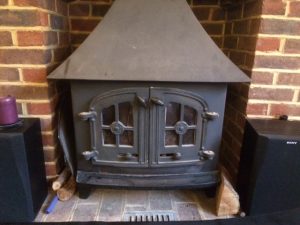
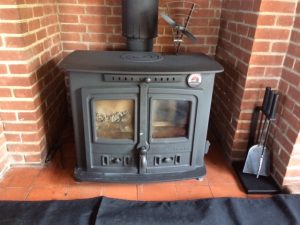
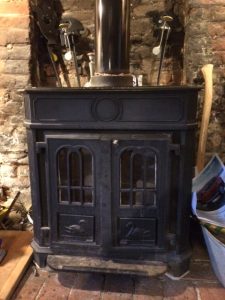
I recently swept and repaired this very large Yeoman County stove at an address in Newport. As can be seen from the pictures, the baffle in this stove had almost completely disintegrated and both the door glasses were cracked and broken.
The baffle repair created something of a problem as in 2006 Stovax who are based in Exeter bought Yeoman Stoves and took over the production of some of their more popular stoves. The problem was that Stovax were no longer producing stoves such as the Yeoman County and were additionally no longer producing replacement parts for these discontinued stoves. Interestingly, Stovax Limited were established in 1981 and tend to produce a more contemporary line of stoves, where as Yeoman Stoves commenced production around about the same time, initially based on a small farm on Dartmoor and have tended to produce more traditional stoves with an emphasis upon a more rustic, rural styling.
So I had a problem, in that I couldn’t just go to the manufacture and buy an off the shelf baffle, because they simply no longer made them. I solved this difficulty by having a completely new baffle fabricated by a blacksmith. I used David Gowlett at Springwell Forge Ugley. David did an excellent job, at very short notice and at a very reasonable price; in fact cheaper than it normally costs to purchase a baffle from a manufacturer. Davids contact details should you need them are:
David Gowlett Blacksmith – Springwell Forge
The Forge, Ugley, Nr Bishops Stortford, Herts CM22 6HY
Forge: 01799 543272
Home: 01638 669326
Mobile:07410 546850
As usual I sourced the glass from VetroSpec in Great Chesterford, I have not found anywhere else that is so reasonably priced and helpful. They will actually cut the glass for you whilst you wait! The proprietors Antonio & Penny Portente are ever so helpful and friendly, I would recommend them to anyone! – VetroSpec – Precision Glass Engineering, Unit 1 Park Farm, Park Road, Great Chesterford, Essex CB10 1RN – T01799531363 – Sales@vetrospec.co.uk – www.vetrospec.co.uk
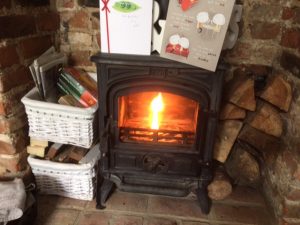
I think you will all agree that the finished stove looks fantastic!