
 My name is Paddy McKeown, I am a retired police officer (Detective Sergeant – Metropolitan Police), turned chimney sweep. I have completed training with ‘The Guild of Master Chimney Sweeps’, and Rod Tech UK (Power Sweeping).
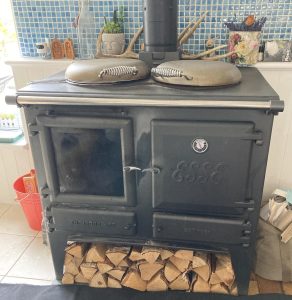
I still sweep a number of wood-fired and solid fuel range cookers across the area, but to be honest they are getting few and far between and the vast majority of them are either Aga’s or Rayburn’s. I was therefore most surprised to find this example of an Esse Lightheart Wood-Fired Range Cooker in the kitchen of a semi-detached house in Saffron Walden. Pleasantly surprised I should say. Across the whole of the area I cover I only sweep one other example of an Esse Wood-Fired Range and that is an old Esse 1000 model in an address in Debden Green. I quite like this new more modern approach to the range cooker that Esse have taken with the Lightheart. My favorite feature is the glass window to the fire-box so that you can see the range in operation when it is lit. Beautiful.
Esse are a long-established company who commenced production of range cookers in 1854 under the direction of a Scot James Smith. In the early 1800’s James decided to emigrate to America. So at the age of just 16 James set off to make his fortune in a romantic style, on foot. He had heard that a barque was soon to set sail from Greenock to New York. In New York he apprenticed himself to a metal worker, his friend Wellstood helping him by signing his indenture papers as his ‘guardian’. after completing his apprenticeship, James worked with a manufacturer in the metal work business in New Orleans before setting up on his own in State Street, Jackson Mississippi. The business appeared to have prospered immediately because after just two years, James could afford to visit Scotland to marry the girl he chose nine years before, at the age of sixteen. Her name was Anne Wells Brown and they set off for a new life in Jackson. While the business prospered, Anne’s health did not. The hot climate was wearing her down, and after a dozen years of it, it became evident that something had to be done.James made the biggest decision of his life. He had successfully been making and selling stoves in America and it occurred to him that the type he specialised in was unknown in Britain. He would go home with his wife and five children and set up business there. So it was that in 1854 James returned to Scotland and made arrangements to set up a business making ESSE stoves. He returned to the States to hand over his old business to his younger brother, Robert A Smith, and his adventures began all over again. On September 17th ‘SS Arctic’, the steamer that he was aboard, was involved in a collision with the ‘Vesta’. James spent three days and two nights awaiting rescue aboard a makeshift raft before being rescued by the ‘Cambria’. James returned to Scotland and the business of manufacturing ESSE cookers and stoves flourished.
By the mid-1900s, ESSE stoves, fires and range cookers were warming all manner of households – from royalty to remote rural homesteads. Early ESSE stoves were primarily designed for the burning of different types of coal. Circa 1910 the ESSE Pioneer Stove was an innovative wood burning stove. The design allowed smoke re-burning to take pace above the firebox before the waste gases entered the flue. Many modern stoves claim to be the originator of this idea, but the ESSE Pioneer refutes these claims. The Pioneer was made in three sizes. Today, wood burning has had something of a renaissance and ESSE makes dedicated woodburning cookers and stoves, alongside multi-fuel appliances. Florence Nightingale was passionate about ESSE cookers and would use no other brand at her hospital in Balaclava. Famous British explorers, Shackleton and Scott, also relied on ESSE to provide hot food and warmth to their expedition team in some of the world’s coldest and most inhospitable places. This tradition is followed by top British climber Alan Hinkes, who uses a specially adapted ESSE Solo to heat his base camp in the Himalayas. In the 1985 an Esse range cooker achieved its screen debut, appearing with Special Agent 007 James Bond in a ‘View to a Kill.’
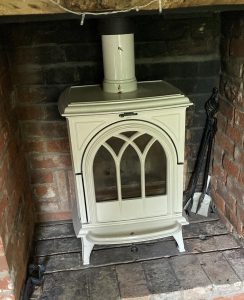
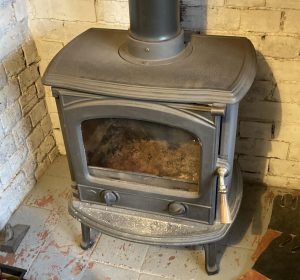

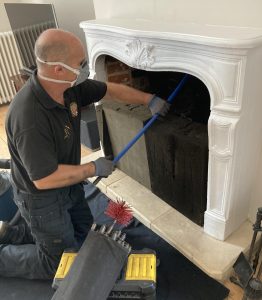
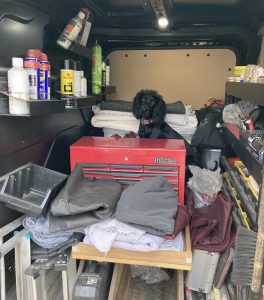 Here we were busy working at an address in Finchingfield doing the chimneys to a couple of large stoves, when we had a cheeky little visitor in the side compartment of the van. This was Poppy the customers little black Cocker Spaniel bitch, presumably on the hunt for some food, Cockers are known to be food obsessed life forms! “Yes, I’m checking out this van, I’m giving it a really good sniffing, but there is no food here”! Poppy is still quite young, not much over a year old, so she is still a pup really and the world is still such an exciting place, so who wouldn’t want to check out something new when it suddenly turns up on your driveway! The customer also have an old Chocolate Brown Labrador called Kato, who was being very well behaved and wasn’t going anywhere near the van and actually looked a bit sheepish, obviously concerned about what naughtiness his younger colleague was getting up to. They both did really make us laugh and brightened the working day.
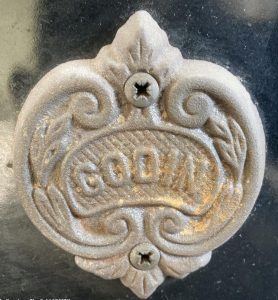
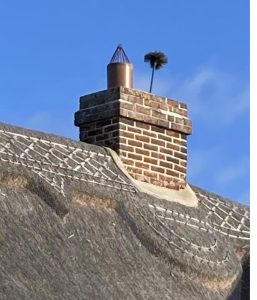
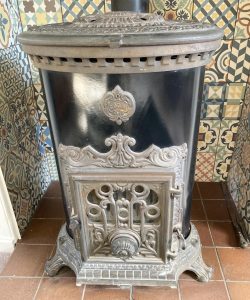 I recently swept this very unusual and attractive tall Petite Godin Stove at an address in Therfield near Royston. These antique stoves are quite a rare find these days, although I have come across one or two of these tall Petite Godin Stoves. I think these antique stoves are rather beautiful and in the right setting they can really add to the ambiance of a room and add value to a property. This stove was an admirable finishing touch to a snug room in an old, thatched cottage. I’m sure its presence means that the snug can be enjoyed by the family all year round! Looking on the internet they really hold their value and are now quite sought after, with a number of websites dealing with their acquisition and sale.