
 My name is Paddy McKeown, I am a retired police officer (Detective Sergeant – Metropolitan Police), turned chimney sweep. I have completed training with ‘The Guild of Master Chimney Sweeps’, and Rod Tech UK (Power Sweeping).
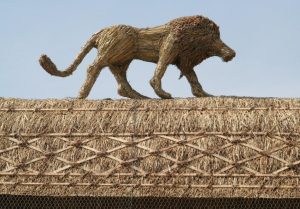
Another exotic thatched animal for todays blog, a majestic lion, but king of the jungle is a real misnomer as everyone knows that the lion lives in the African savannah. What is certain hear is that this fellow certainly is a handsome chap, if not a little incongruous sight on the roof of a thatched cottage in Britain? I like him though, I think you must admit that he has a certain style, perhaps class and certainly a dominating presence. Real gravitas if ever I saw it!
The lion (Panthera leo) is a species in the family Felidae and a member of the genus Panthera. It has a muscular, deep-chested body, short, rounded head, round ears, and a hairy tuft at the end of its tail. It is sexually dimorphic; adult male lions have a prominent mane. With a typical head-to-body length of 184–208 cm (72–82 in) they are larger than females at 160–184 cm (63–72 in). It is a social species, forming groups called prides. A lion pride consists of a few adult males, related females and cubs. Groups of female lions usually hunt together, preying mostly on large ungulates. The lion is an apex and keystone predator; although some lions scavenge when opportunities occur and have been known to hunt humans, the species typically does not.
Typically, the lion inhabits grasslands and savannas, but is absent in dense forests. It is usually more diurnal than other big cats, but when persecuted it adapts to being active at night and at twilight. During the Neolithic period, the lion ranged throughout Africa, Southeast Europe, and Western and South Asia but today it has been reduced to fragmented populations in sub-Saharan Africa and one critically endangered population in western India. It has been listed as Vulnerable on the IUCN Red List since 1996 because populations in African countries have declined by about 43% since the early 1990s. Lion populations are untenable outside designated protected areas. Although the cause of the decline is not fully understood, habitat loss and conflicts with humans are the greatest causes for concern.
One of the most widely recognised animal symbols in human culture, the lion has been extensively depicted in sculptures and paintings, on national flags, and in contemporary films and literature. Lions have been kept in menageries since the time of the Roman Empire and have been a key species sought for exhibition in zoological gardens across the world since the late 18th century. Cultural depictions of lions were prominent in Ancient Egypt, and depictions have occurred in virtually all ancient and medieval cultures in the lion’s former and current ranges.
Here is a selection of Lion poems I found on the internet:
The Lion by Hilaire Belloc
The Lion, the Lion, he dwells in the Waste,
He has a big head and a very small waist;
But his shoulders are stark, and his jaws they are grim,
And a good little child will not play with him.
The Lion by Waytoolost
The Lion is a predator.
The Lion is not the type of leader you think it is.
It is the type of leader to be admired from afar.
The Lion is the type of leader that everyone respects and no-one wants to anger.
The Lion is brave, quiet, courageous and powerful.
The Lion is the King.
Nothing will ever change that The Lion is King.
When you see The King, you better be running because you know, you don’t stand a chance.
Perhaps my favourite lion poem, certainly the funniest, this offering from the pen of Spike Milligan.
If you’re attacked by a Lion
Find fresh underpants to try on
Lay on the ground quite still
Pretend you are very ill
Keep like that day after day
Perhaps the lion will go away
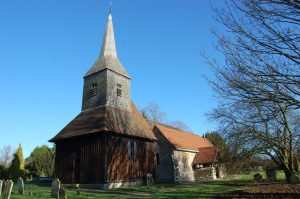
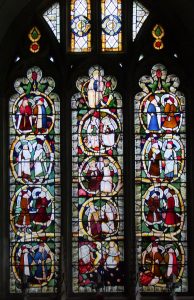
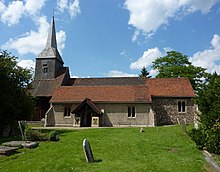 Here we are sweeping for the Bishop of Chelmsford again, and on this occasion it was the vicarage at Margaretting near Ingatestone, close to Chelmsford. We have swept the vicarage chimney on around four or five occasions now and are quite familiar with it. To be honest it is a really quick job, an open fire with a modern lined chimney that is swept regularly (by me), and that only has occasional use. So on this occasion as we didn’t have a particularly busy day and the job only took a small amount of time, we could spend a few moments examining what is a beautiful medieval church. A church that I would say is architecturally classically Essex with its wooden bell cote and spire.