

 My name is Paddy McKeown, I am a retired police officer (Detective Sergeant – Metropolitan Police), turned chimney sweep. I have completed training with ‘The Guild of Master Chimney Sweeps’, and Rod Tech UK (Power Sweeping).
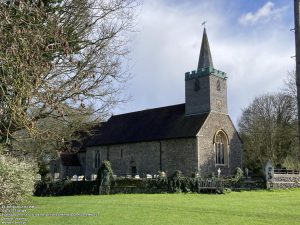
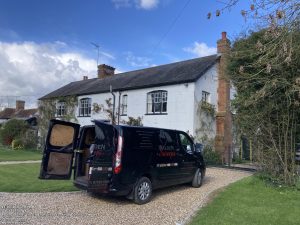
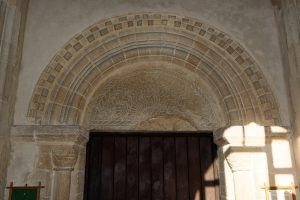 No, on this occasion I was not sweeping for the Bishop of Chelmsford when I visited great Canfield church, but for a private customer who lives in a large house nearby. The thing that strikes you immediately when approaching this small Essex church is its Norman doorways. These Romanesque doorways assist in dating the church back in the past as far as the Norman period. After a walk around the outside of the church examining the flint fabric, I was excited to have a look inside. However, I was quickly disappointed as the church was locked. There were however the details of the Church Warden from whom the key could be obtained. Unfortunately, I had other jobs to do and was somewhat time pressured, so I did not have the time to obtain the key and have a look around. Reading further on the internet, it would appear that I missed a real treat, and I will therefore have to make the time for a return visit when I have more time.
The Norman doorways of the church are not the only external features that place the church in the Norman period. Close by are the remains of a Norman Mote and Bailey Castle. The castle was built by the De Vere family who were the Earls of Oxford and who also built the notable Norman castle at Castle Headingham which survives intact to this day. The castle at Great Canfield, while clearly not in the same league as Castle Hedingham, is nonetheless a particularly fine example of its type. The earthworks are large and impressive and its ditches, which also include a partial diversion of the river Roding, indicate the power of its owners.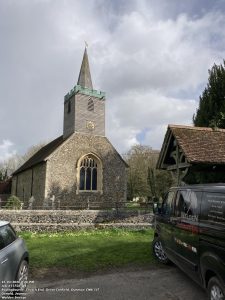
The present church at Great Canfield dates back to the time of the Mote and Bailey Castle, but probably replaced an earlier church. The church itself is rather impressive and is evidence of the wealth of its once powerful benefactors the De Vere family. On entering the porch the visitor is confronted with a most unusual Norman doorway. The tympanum itself is fascinating with it stylised “rising sun” chevron work and billeted extrados but the real interest lies just below in the capitals. Here, on the left, is thought to be a representation of Odin with the ravens Huginn (thought) and Muninn (memory) whispering to him. On the return there is a row of five swastika carvings. The opposite capital features another Norse face and what appears to be a snake. Whether these are indeed Norse carvings or perhaps relate to Biblical stories is unclear, yet the Norse style of execution is compelling. It is possible that these carvings originate from an earlier building.
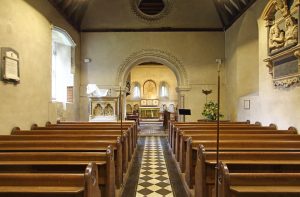
Inside the church there is a wealth of architectural features, chief amongst these is the magnificent Norman chancel arch. In addition, there is a Thirteenth-Century wall painting featuring an image of the Virgin Mary which Nikolas Pevsner considered to be the finest in the country. It is believed that the wall painting, and the accompanying decoration on the east wall, may once have formed an unusual painted reredos. 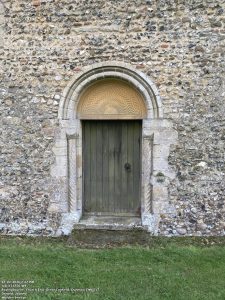





Comments are closed.