

 My name is Paddy McKeown, I am a retired police officer (Detective Sergeant – Metropolitan Police), turned chimney sweep. I have completed training with ‘The Guild of Master Chimney Sweeps’, and Rod Tech UK (Power Sweeping).
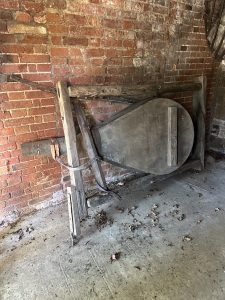 Our Emma seems to be dominating my weekly blog at present, next week I really must do something heritage wise of my own making. As I have previously said, our Emma works as a Heritage Town Planning Consultant, and she recently visited the site of a renovation project involving an old smithy and stable block in Northamptonshire. Pictured is what she found at the site, a massive pair of bellows, presumably for use in the forge, forcing air into the fire to get it hot enough so metal working should take place. My thought immediately was what sort of chimney was used in the forge, but unfortunately the chimney no longer exists. What a shame.
Metal working has always had magical, quasi-religious connotations and certainly the smith was something of a venerated character in local communities. This probably dates back to prehistory when the work of the blacksmith would have simply been seen as a form of magic; the turning of rock into metal implements and weapons. Interestingly, Saint Eligius (also known as St. Eloy or Éloi) is the primary patron saint of blacksmiths, as well as metalworkers, farriers, and goldsmiths. His feast day is 1 December, and he is widely venerated for his legendary skill as a metalsmith and his association with horses and metalworking trades. There are also stories associated with Saint Dunstan and the Devil that involve smithing. There is one story that tells how Saint Dunstan caught the devil by the nose with a pair of red-hot tongs and in another tale he is said to have put horseshoes on the devils cloven hooves, this is supposed to be the origin of the practice of hanging lucky horseshoes over doorways. It is also suggested that Dunstan is also the patron saint of goldsmiths, silversmiths, blacksmiths, armorers, and jewellers.


Comments are closed.