

 My name is Paddy McKeown, I am a retired police officer (Detective Sergeant – Metropolitan Police), turned chimney sweep. I have completed training with ‘The Guild of Master Chimney Sweeps’, and Rod Tech UK (Power Sweeping).
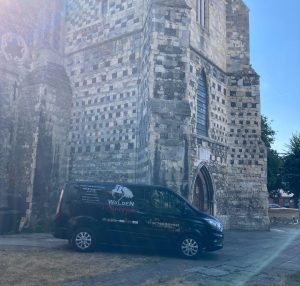
Here is more on our visit to Waltham Abbey to sweep the chimney at the rectory. Right next door to the Rectory is Waltham Abbey Church which is dedicated to the Holy Cross and St Lawrence. At the rear of the church is a dedication stone marking the beleived burial place of king Harold Godwinson the last Anglo-Saxon king of England. There have been a total of five churches built at the site, three of which dated to the Anglo-Saxon period. The church is a Grade I Listed Building: Listing No: 1124155, Date listed: 26 Jan 1956. The present building dates mainly from the early 12th century and is an example of Norman architecture. To the east of the existing church are traces of an enormous eastward enlargement of the building, begun following the re-foundation of the abbey in 1177. In the Late Middle Ages, Waltham was one of the largest church buildings in England and a major site of pilgrimage; in 1540 it was the last religious community to be closed during the Dissolution of the Monasteries.
Archaeological investigations between 1984 and 1991 revealed a much earlier origin of the site than had previously been believed. There is evidence for five distinct churches at Waltham.
First church at Waltham (7th century)
Traces of the flint rubble foundations of a 7th-century wooden church have been found under the choir of the present building; an associated burial has been radiocarbon dated to between 590 and 690. A proposed date of circa 610 would place its construction in the reign of Sæberht of Essex, who was noted for his church-building activities. Other finds included a 7th-century Kentish jewellery book-clasp depicting eagles grasping a fish.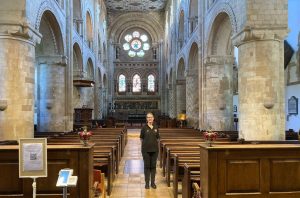
Second church (8th century)
During the reign of King Offa of Mercia, whose rule extended to the Kingdom of Essex in the late 8th century, a building of Barnack stone was constructed around the earlier wooden church. It was half the length of the present building, and was a porticus-type church with chambers along each side of the nave. It was intended as a minster serving several communities in the area.
Legend of the Holy Cross
At the beginning of the 11th century, the church and manor of Waltham were held by an Anglo-Danish thegn called Tovi the Proud. A legend, recorded in the 12th-century De Inventione Sanctœ Crucis Nostrœ (“The Discovery of our Holy Cross”) or “Waltham Chronicle”, relates that, in about 1016, the blacksmith at another estate belonging to Tovi, at Montacute near Glastonbury, found a large black flint (or marble) crucifix buried at the top of a hill, after a dream. Tovi had the cross loaded onto an ox-cart, but the oxen would only go in one direction and continued every day until they reached Waltham, a journey of some 150 miles. This Holy Rood or Cross was installed at the church and soon became the subject of pilgrimage. Tovi is said to have rebuilt the church, but modern evidence suggests that he probably retained the 8th-century fabric of the building.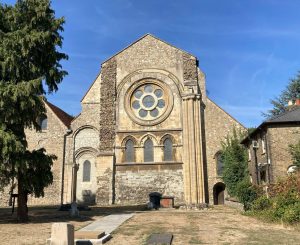
Third church (King Harold’s foundation)
After Tovi’s death, his son fell into debt and the estate passed to King Edward the Confessor. He then gave it to Harold Godwinson (later King Harold II), who rebuilt, refounded and richly endowed the church, which was dedicated in 1060; a legend says that this was because in his childhood, he had been miraculously cured of paralysis by the Holy Cross. The new church was placed under the control of a dean and a college of twelve married priests. Evidence suggests that stone and some of the foundations of the previous church were re-used for the new building, which had a nave the same length as the present one, aisles, a large transept and a small eastern apse.
Fourth church (Norman)
Starting in about 1090, Harold’s building was demolished and a new church with crossing tower and transepts was begun in the Norman style. It reused the Saxon foundations and some of the stonework, with additional stone from Reigate, Kent and Caen in Normandy. The church was cruciform, with a tower at the crossing and two smaller towers at the west end. The nave had typically massive Norman pillars with incised decoration and semi-circular arches supporting a triforium and clerestory above. A long eastern chapel may have housed the Holy Cross. The rebuilding, which had started at the eastern end, was completed by about 1150. Although there is a marked stylistic resemblance to Durham Cathedral, a recent study of the features of the church and comparison with other sites has concluded that the master mason at Waltham was trained in East Anglia. This construction is mainly the fabric that has survived to the present.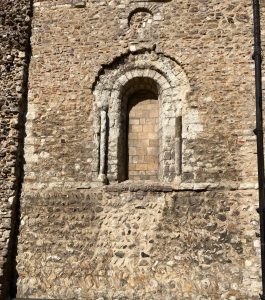
Fifth church (the Augustinian Abbey)
In 1177, the abbey was re-founded once more, this time as an Augustinian priory with 16 canons, by Henry II as part of his penance for the murder of Thomas Becket. The rebuilding, in the Early English style, made the abbey far more extensive than the original Norman establishment, as can be seen today from traces in the abbey grounds. Those parts of the Norman church east of the Norman crossing were demolished, and a new church, with its own nave, a second pair of transepts and a further tower at the new crossing, were constructed. The Norman nave was retained as a parish church, divided from the new work by a screen. The whole building was now longer than Winchester Cathedral. A cloister was built to the north of the new nave. A short passage that led into the cloister still exists; this, and a fourteenth-century gatehouse, are the only surviving monastic buildings.[3]
In 1184, Henry raised the status of the church to an abbey; he appointed an abbot and the number of canons was increased to 24. The completed abbey was finally re-dedicated on 30 September 1242, by William de Raley, Bishop of Norwich. The Holy Cross attracted many pilgrims and the Abbey became a popular place for overnight stays for kings and other notables hunting in Waltham Forest. Henry VIII was a frequent visitor and is said to have had a house or lodge at Romeland, adjacent to the abbey. During their summer progress of 1532, Henry and Queen Anne Boleyn stayed at Waltham Abbey for five days.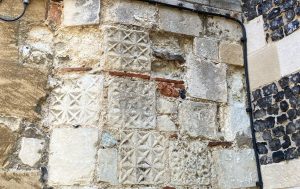
The Dissolution
Waltham was the last abbey in England to be dissolved. On 23 March 1540, the last abbot, Robert Fuller, surrendered the abbey and its estates to Henry’s commissioners, the annual income from which was valued at £1,079, 12 shillings and one penny. In return, the abbot received a generous pension in the form of estates with an annual income of £200; the prior received an annuity of £20 and sixteen canons each received between £5 and £10 depending on seniority. Thomas Tallis, who had taken up a post as a senior “singing-man” (often interpreted as choir master) in the autumn of 1538, was awarded 20 shillings in outstanding wages and 20 shillings “reward”. Tallis went on from Waltham to a post in the choir at Canterbury Cathedral. The Holy Cross disappeared without trace at this time. King Henry suggested Waltham as one of the new cathedrals for the Church of England, but this proposal was not implemented. In 1541, the king leased the manor of Waltham to Sir Anthony Denny, a prominent member of the Privy chamber and a confidant of the king. When Denny died in 1549, his estates passed to his widow Joan and in 1553 she bought the manor of Waltham outright; she died in the same year. The manor then passed to her son Henry, who died in 1574 leaving two sons; the elder Robert, died in 1576 and was succeeded by Edward Denny, who became Baron Denny of Waltham in 1604 and Earl of Norwich in 1626. Edward reused the stones from the demolished Gothic choir and chancel (the fifth church) for the sumptuous Abbey House which he built to the north of the churchyard; the Norman remnant of the nave continued in use as the town’s parish church.
Later architectural history
In 1553, shortly after the demolition of the 12th-century choir, crossing and chancel, the 11th-century Norman tower at the east end of the nave collapsed. It was replaced by a new tower at the opposite end of the church, abutting the 14th-century west wall and straddling the main doorway. Work commenced in 1556 and was completed in the following year; it was the only church tower built in England during the reign of Queen Mary I.





Comments are closed.